


 +86 18130251359
 teflowpumps@tlpumps.com

Rare earth hydrometallurgy is the core process of rare earth separation and processing. The entire production line handles large volumes of strong acid media, ranging from ore leaching, solvent extraction and separation, precipitation reaction, pickling before calcination, to rare earth feed liquid transfer, mother liquor recovery and end-of-line rare earth wastewater treatment. The media include hydrochloric acid, sulfuric acid, oxalic acid and rare earth salt solutions. Many processes involve solid ore slurry particles, presenting tough operating conditions: strong corrosion, solid particles, easy crystallization and precipitation of metal ions.
As core fluid-handling equipment, improperly selected pumps are prone to corrosion perforation, impeller wear, seal leakage, pump blockage by crystallization and metal ion contamination of products. These issues directly affect rare earth product purity, continuous production efficiency and workplace safety.
I. Operating Characteristics & Pump Selection Guidelines for Each Rare Earth Process
1. Rare Earth Ore Leaching
The leaching process mixes rare earth ore with acid for reaction. The medium is sulfuric/hydrochloric acid ore slurry containing abundant solid ore particles, featuring strong corrosion and high solid content.
Key challenges: Severe erosion and wear by particles, strong acid corrosion on pump body; ore slurry tends to settle and block the pump after shutdown.
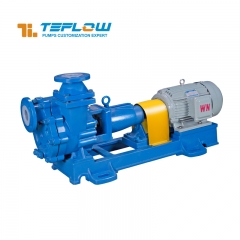
Recommended pump: Fluorine-lined mortar pump. Its wetted parts are made of UHMWPE (ultra-high molecular weight polyethylene), delivering both strong resistance to concentrated acid corrosion and particle abrasion, ideal for ore slurry transfer. Equipped with an open impeller for excellent anti-clogging performance to reduce slurry blockage, suitable for batch and continuous leaching slurry transport.
2. Solvent Extraction & Separation
The extraction section conveys rare earth feed liquid and pickling solution, mostly dilute hydrochloric acid and rare earth salt solutions with trace suspended solids. Strict control of metal ions is required. Dissolved metal from pump components will contaminate rare earth products and reduce purity.
Key challenges: Strict control of metal leaching, easy medium crystallization, zero leakage requirement to stabilize the extraction system.
Recommended pump: Fluoroplastic magnetic drive pump. The seal-free design achieves complete zero leakage. All wetted parts are made of fluoroplastic with no metal contact with the medium to eliminate metal ion dissolution. Magnetic drive removes mechanical seals and prevents seal failure caused by crystallization, suitable for circulation transfer of clean rare earth feed liquid.
3. Precipitation Process
The precipitation process transports oxalic acid and rare earth salt precipitate slurry. Fine solid rare earth precipitates form during reaction. The medium is corrosive and fine particles easily adhere and crystallize inside the pump cavity.
Key challenges: Fine particle adhesion inside pump chamber, crystallization and scaling that block flow passages.
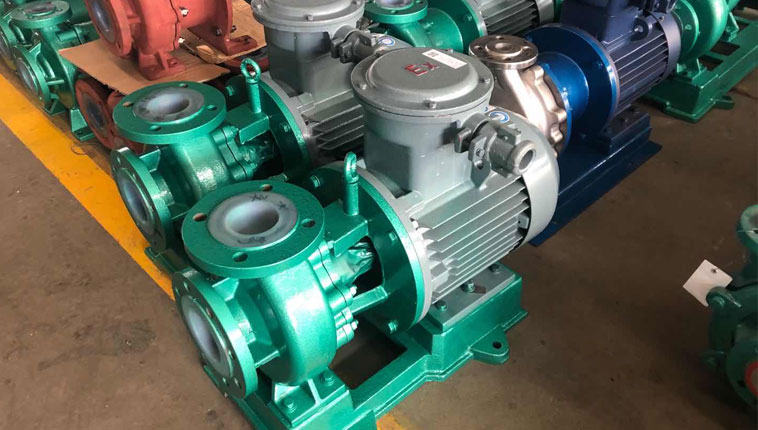
Recommended pump: Fluorine-lined centrifugal pump. Fully fluoroplastic wetted components resist corrosion by oxalic acid and salt solutions. Wide flow passages reduce sediment adhesion. A flushing port can be fitted for regular pump cavity cleaning to prevent crystal accumulation. For media with higher solid content, fluorine-lined mortar pump is preferred.
4. Pickling before Calcination
Pickling before calcination uses hydrochloric acid and dilute sulfuric acid to remove impurities from rare earth precursors. The medium has elevated temperature, strong acidity and a small amount of solid powder.
Key challenges: Combined damage from high-temperature strong acid and particle erosion (corrosion + wear).
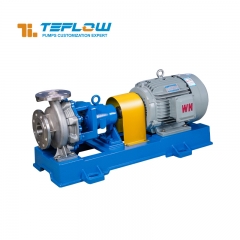
Recommended pump: Steel fluorine-lined centrifugal pump. Carbon steel substrate guarantees structural strength while internal fluoroplastic lining withstands strong acid corrosion. Wear-resistant lining resists powder erosion for medium-temperature pickling liquid transfer.
5. Mother Liquor Recovery
Mother liquor contains residual acid and rare earth ions with strong corrosivity. Transfer is intermittent, and crystals easily precipitate when the medium stands still.
Key challenges: Intermittent start-stop operation, crystal precipitation, zero leakage requirement to avoid material loss and environmental risks.
Recommended pump: Fluoroplastic magnetic drive pump. Seal-free and leak-proof design. Crystals are less likely to damage seals during frequent start-stop cycles. Applicable for mother liquor circulation and transfer to cut material loss.
6. Rare Earth Wastewater Treatment
Rare earth wastewater has complex composition with mixed acids, heavy metal ions and fine suspended solids, and fluctuating water quality. Environmental regulations prohibit any leakage.
Key challenges: Variable water quality, corrosion plus minor solid particles; leakage may trigger environmental incidents.
Recommended pump: Fluorine-lined self-priming pump / fluorine-lined centrifugal pump. Fluoroplastic material adapts to variable acidic wastewater. Self-priming version enables liquid extraction from low-level wastewater tanks without priming, for wastewater transfer and chemical dosing.
II. Four Mandatory Criteria for Pump Selection in Rare Earth Industry
1. Strong acid resistance: Media include hydrochloric acid, sulfuric acid and oxalic acid. Ordinary stainless steel cannot withstand long-term corrosion. Fluoroplastics (PTFE/F46/PFA) are preferred for wetted parts to avoid rapid pump corrosion and failure.
2. Wear resistance for solid particles: Leaching and precipitation processes carry ore slurry and solid powder. Impeller and pump cavity require wear-resistant fluoroplastic lining. Open/semi-open impellers are adopted for high solid content media to reduce particle jamming.
3. Zero leakage & anti-crystallization: Zero tolerance for leakage in extraction and mother liquor recovery. Magnetic drive pumps with no shaft seal are the top choice. Mechanical seal configurations must be equipped with flushing systems to prevent medium crystallization from locking seal faces.
4. Low metal leaching: High-purity rare earth production forbids metal ions dissolving into feed liquid. All medium-contacting pump parts must adopt non-metallic fluoroplastic. Stainless steel and carbon steel shall not directly contact feed liquid to guarantee rare earth product purity.
Operating conditions vary greatly across rare earth hydrometallurgy processes. General chemical pumps cannot be simply adopted. Fluorine-lined mortar pumps are selected for high-solid ore slurry such as leaching media; fluoroplastic magnetic drive pumps are prioritized for clean feed liquid in extraction and mother liquor recovery; steel fluorine-lined centrifugal pumps and fluorine-lined self-priming pumps are applicable for pickling and wastewater treatment. With fluoroplastic as the core wetted material to meet four core requirements — strong acid resistance, wear resistance, zero leakage and low metal leaching, pumps can adapt to harsh rare earth working conditions, ensure stable continuous production, cut downtime maintenance costs and safeguard rare earth product quality.



 +86+0563-5093318
